Dental implants
Firmly anchored replacement for one or several missing teeth.
What is Dental implants?
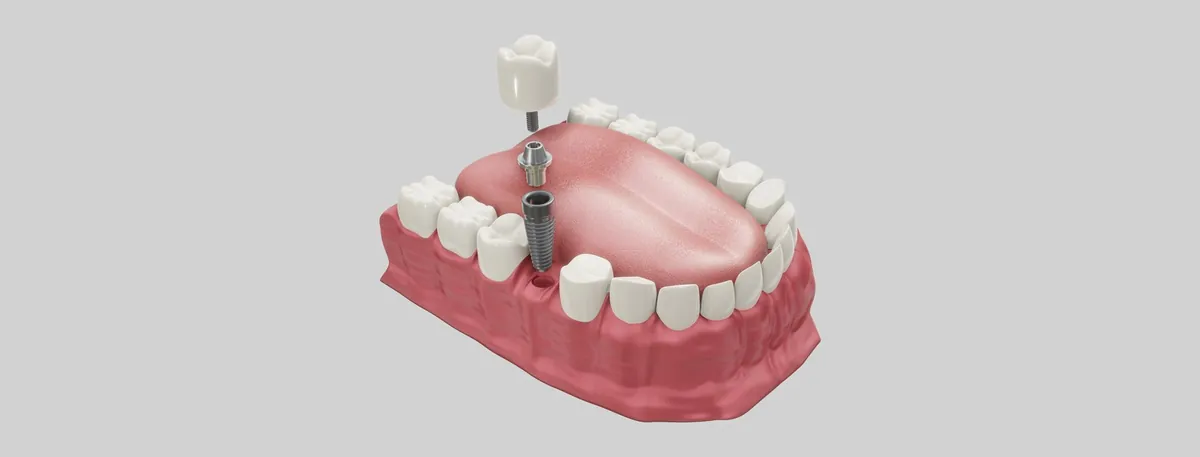
An implant replaces the tooth root and carries a crown, bridge or denture. We place titanium implants from ICX and Straumann as well as metal-free ceramic implants from Zeramex, each with a laboratory-made crown. With 3D X-rays we plan position and depth to the millimetre; where bone is missing, we build it up – often while placing the implant, in the upper jaw for example with a sinus lift.
In four steps
- 013D X-ray & planning
- 02Placing the implant
- 03Healing phase
- 04Crown on the implant
FAQ
An implant does not require the neighbouring teeth to be ground down, so their tooth substance is preserved. Like a natural tooth root, it also stimulates bone formation and so prevents bone loss in the jaw. And it is well proven: around four decades of experience show that over 90% of implants heal into the jawbone and permanently take over the function of the tooth root.
Yes, but usually only temporarily: for example periodontitis or tooth decay, heavy smoking, a jaw that is still growing (under 17), poorly controlled diabetes or an increased tendency to bleed. Permanent reasons can include taking bisphosphonates, an irradiated jaw, chemotherapy or severe heart, circulatory, liver or kidney disease – in these cases a doctor assesses whether an implant is still possible.
Both materials are well tolerated. Titanium is robust, light and fuses firmly with the bone – it remains the first choice. Zirconia ceramic is light in colour like a tooth and barely shows through the gum, but takes longer to heal in; until then a splint protects the implant from being loaded too early. Which material suits you also depends on your jaw – we discuss it with you beforehand.
Then we build it up – often in the same session in which we place the implant. Depending on the situation, a jaw that is too narrow is spread or split, one that is too low is raised, or the socket is filled after a tooth has been removed (socket preservation). The material used is your own bone, which the body does not reject, or a bone substitute made from donor bone, animal or plant tissue or synthetic material.
We lift the floor of the maxillary sinus and fill the space beneath it with bone substitute. If two to three millimetres are missing, this is done minimally invasively through the implant's drill hole with an osteotome (internal sinus lift); for more than 3 mm, through a small bone window on the outside (external sinus lift). With the Balloon-Lift-Control system, a fluid-filled balloon lifts the membrane particularly gently – even by more than 10 mm.
From your own blood we obtain platelet-rich plasma (PRP), which contains the body's own growth factors – a purely biological way of building up bone. It speeds up new bone formation, so the implant can be loaded sooner, and helps the wound heal faster, which lowers the risk of infection. Especially where wound healing is impaired, for example in smokers or people with diabetes, this markedly reduces complications.
The risks are low and rarely occur. As with any procedure, inflammation, wound-healing problems or infection can occur; occasionally the substitute material does not fuse with the bone and has to be removed again. If the fine membrane of the sinus is injured, temporary numbness can develop, which as a rule does not last.
From placement to the finished crown usually 3 to 6 months, a little longer with bone augmentation.
Usually not. Where necessary, we use local anaesthesia. For anxious patients we also offer treatment under general anaesthesia.
In Switzerland, dental treatment is usually not covered by basic health insurance. Many supplementary insurance plans contribute – we will gladly prepare a cost estimate for you to submit.
Usually within the same week – and on the same day if you are in pain. We offer emergency treatment Monday to Saturday until 21:00.